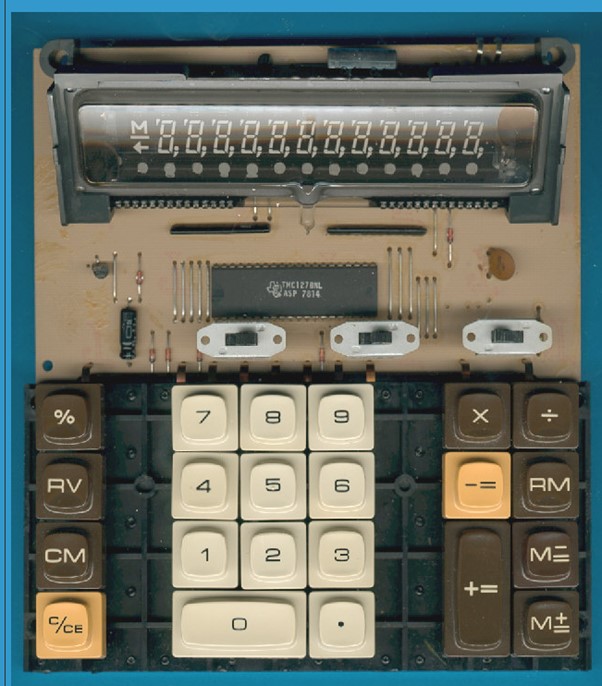
This working model was obtained from a local car boot sale. The TI-5200 was a desktop calculator introduced by Texas Instruments in January 1977 priced at around $150 USD.
The main features are:
- 12-Digit Fluorescent Display: This was a significant upgrade from the 10-digit displays commonly found in earlier models, providing clearer and more detailed readouts.
- Integrated Circuit Technology: It utilized a 40-pin TMC1278 integrated circuit from the TMS1000 microcomputer family, enhancing its computational power and efficiency.
- Advanced Mathematical Functions: The TI-5200 offered a range of advanced functions, such as percentage calculations and square roots, which were not always available in other calculators.
- Memory Functions: While basic, the inclusion of memory functions allowed users to store and recall numbers, adding to its versatility.

The concept of integrating electronic circuits into a single device was first proposed by British engineer Geoffrey Dummer in 1952. However, it wasn’t until 1958 that Jack Kilby of Texas Instruments created the first working IC, which was a hybrid IC made from germanium. Around the same time, Robert Noyce at Fairchild Semiconductor developed the first monolithic IC using silicon, which became the standard for modern ICs.
Handheld calculators were introduced into the United States in 1970 and 1971 by the Japanese firms of Busicom (Nippon Calculating Machine Corporation) and Sharp (Hayakawa Electric) as well as the American firm of Bowmar. Chips in early Busicom calculators were made in the United States by Mostek, while those in the Bowmar and Canon were by Texas Instruments.
Three variations of the TI-5200’s appearance have been identified at the Calcuseum site but all conform to the same technical specification.
In order to display 12 digits instead of 10 a 40-pin TMC1278 was introduced instead of the 28-pin TMC1073 of the earlier TMS-5100.
I was only able to obtain copies of the operating manuals for earlier models – model TI-5100 with a plug for a normal power supply and TI-5100 II with battery power. The method of operating the TI-5200 was identical to that in the TI-5100 manual except as regards the following.
The Decimal S/R button was labled ‘F/2’ on the TI-5100 and was stated to provide full floating decimal or positions decimal automatically at 2 places for financial operation.
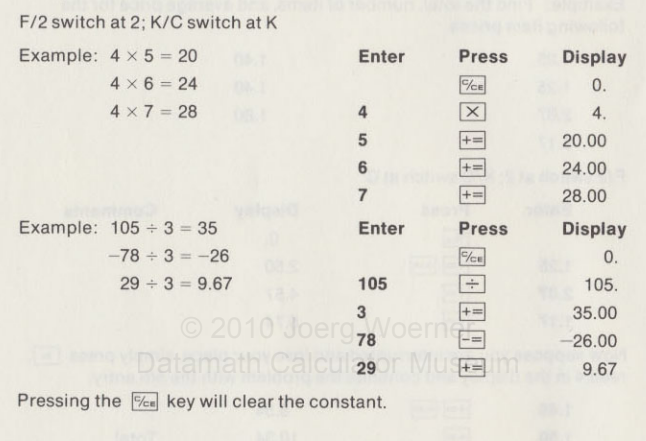
Also, the button ‘RV’ on the TI-5200 is marked ‘N’ on the TI-5100. The ‘RV’ button seems to show the most recent value that was keyed in while the ‘N’ button on the TI-5100 was stated to display the number of += and -= operations since the clear key was entered. An example of its use is shown below from the manual.
Multiplication and Division by a Constant
The K/C switch increases the flexibility of the TI-5100 calculator by allowing the user to multiply or divide a series of numbers by a constant number.
When the K/C switch is in the K position, a number entered before a [X] or after a [= function key is retained as a constant multiplier or divisor. So here the constant K is ‘4’ or ‘3’.
History of Texas Instruments
The company’s roots trace back to the Geophysical Service Inc (GSI), founded in 1930 to provide seismic data for the petroleum industry. In World War II GSI transformed into a defence contractor, developing submarine detection devices and other electronic equipment. In 1951, GSI was reorganised and renamed Texas Instruments.
With the coming of the semiconductor revolution in the 1950s and 60s TI produced the world’s first commercial silicon transistor in 1954. Jack Kilby, a TI engineer, co-invented the integrated circuit (IC) in 1958, a breakthrough that laid the foundation for modern computing beginning with developments such as handheld calculators.
Diversification followed with development and manufacture of early microprocessors, including the TMS1000 series, which were used in various applications. TI became a leader in Digital Signal Processor technology (DSP), producing chips for audio, video, and communications. The company also expanded into consumer electronics, producing products like the Speak & Spell educational toy and the TI-80 series of graphing calculators. Continued innovation is exemplified by its design, manufacture, testing and selling of analog and embedded processing chips which are the essential building blocks of electronic systems.
The chip that could have powered the PC revolution
TI has also had its disappointments – the TMS9900. In the early 70s the “Big 3” semiconductor companies – Fairchild, Motorola, and TI – were attempting to make the transition from bipolar integrated circuits to metal-oxide-semiconductor circuits. In the late 1970s Walden C. Rhines gave a presentation of the 16-bit TMS99110, then code-named “Alpha”, to an IBM group developing a personal computer. They were competing against Motorola with their 64K and Intel with 8086 architectures. IBM was keen to bring their PC quickly to the market and chose the readily available Intel product, although the Motorola processor my have been superior. TI still wanted to pursue the market so the TI-99/4, as it was called, was introduced in 1979, followed by the TI-99/4A in 1981. The company eventually sold 2.8 million units, most of them at a significant loss, before pulling out of the home computer market in 1984.
Sources of information include
Engineering the World: Stories from the First 75 Years of Texas Instruments. Caleb Pirtle III
ISBN 10: 0870745026 / ISBN 13: 9780870745027 Published by Southern Methodist University, 2005